
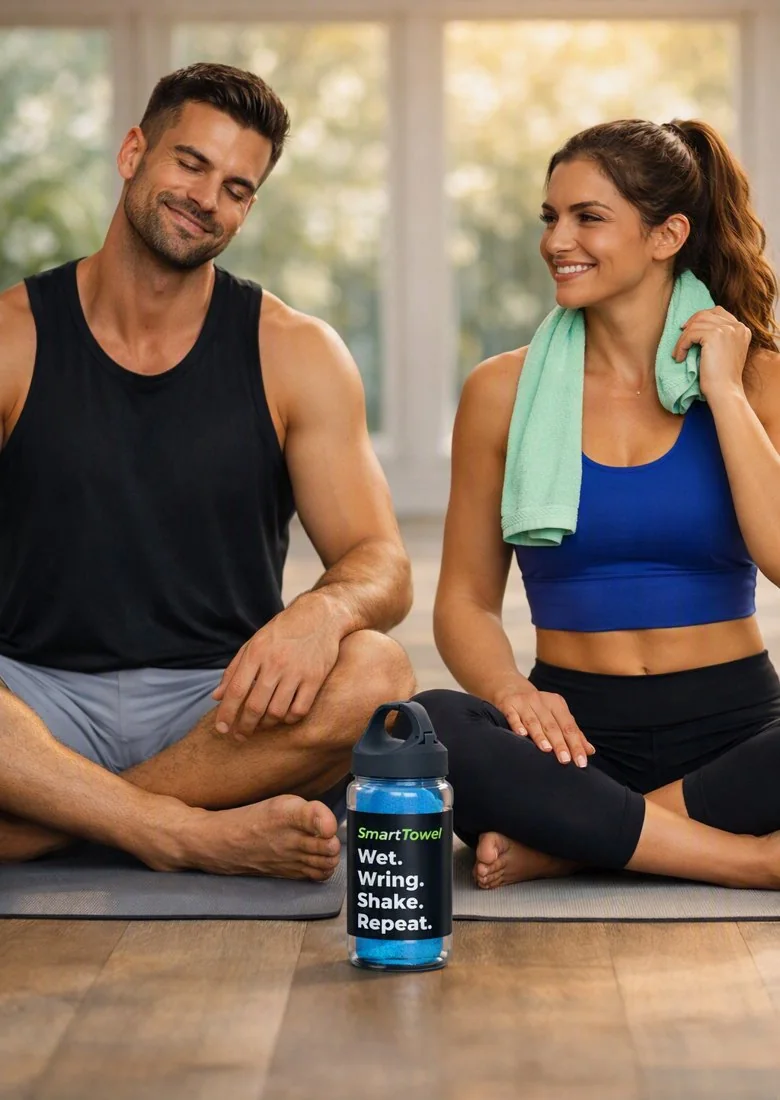
Gyms run hot. Bodies generate heat, equipment generates heat, and ventilation is usually designed for the building rather than for the person doing their eighth set of squats in the corner. In summer, or in a busy free-weights area, air conditioning often loses.
A cooling towel is a small fix for a specific problem: staying comfortable through a long session without needing anything plugged in.
Why the neck placement matters in the gym
Between sets you have a short window, sometimes 60 to 90 seconds, to bring your body temperature and heart rate back down before the next one. Draping a cooling towel across the back of your neck during that window works well because blood vessels run close to the surface there, so cooling that area influences overall comfort out of proportion to how small it is.
It also happens to be the one placement that stays put without you holding it, which matters when your hands are busy.
The two-towel system
This is the single most useful habit for gym use.
Bring an ordinary towel for wiping benches, equipment and your face, and a cooling towel purely for cooling. Do not let them swap jobs.
The reason is fabric. A cooling towel is engineered to spread water into a thin film so it evaporates fast. An absorbent gym towel is engineered to soak liquid up and hold it. Use the cooling towel as a wiping cloth and you load it with sweat, skin oils and whatever was on the bench, all of which coat the fibre structure and dull the cooling over time. Use the ordinary towel to cool yourself and it just sits there wet.
Two towels, two jobs. Both last longer.
A realistic session routine
- Activate before you start, not once you are already hot. Wet it in the changing room tap, wring it out firmly until it is damp rather than dripping, and shake it out. Recovering from overheating takes far longer than staying ahead of it.
- Wear it between sets, across the back of the neck.
- Take it off for lifts where a loose towel is a hazard. Anything overhead, anything with a bar path near your neck, anything on a machine with moving parts. Hang it on the rack. This is not a cooling consideration, it is a safety one.
- Re-wet at the halfway point if the session is long. Water fountains work fine. It does not need to be cold water.
- Rinse it before you leave and hang it to dry at home.
Cardio versus lifting
They are different problems.
On cardio, particularly a treadmill or bike, you have continuous airflow across your body, which is exactly the condition evaporative cooling likes best. A cooling towel across the neck works noticeably well here, and stays out of the way.
On lifting, you are producing heat in short intense bursts with rest in between, and there is very little airflow. The towel does less during the set and more during the rest, which is fine, because the rest is when you actually want to cool down. Expect it to feel most useful in those 90-second gaps.
In a hot yoga or studio class, be realistic: high heat plus high humidity is the hardest condition for evaporative cooling, because the air is already close to saturated. The towel still helps, since damp fabric against skin conducts heat away regardless, but the effect is gentler than it would be in a dry gym.
Kit bag practicalities
The thing that stops most people using a cooling towel regularly is not performance, it is that a wet towel is annoying to carry home. Ours ships with a carrier case and hook for exactly this reason: it clips to a bag rather than soaking the inside of one.
When you get home, hang it up. Damp fabric balled in a gym bag overnight is how any kit develops a smell, and a cooling towel is no different.
What not to do
- Do not wash it with fabric softener. Softener leaves a waterproofing film on the fibres, which is precisely what an evaporative fabric must not have. This permanently weakens the cooling and it is the most common way people ruin one.
- Do not use it as a lifting strap, a grip aid or a bench cover. Abrasion damages the fibre structure.
- Do not leave it draped over your neck during heavy overhead work. Worth repeating.
- Do not expect it to replace hydration. Feeling cooler is not the same as being hydrated, and a cooling towel does nothing about fluid loss.
More: how to use a cooling towel, how to wash one, or the full guide to cooling towels.